
Report (On) Your Local Sheriff
Coverage of 287(g) agreement swallows Soldan's shaky story whole


A big reason I don’t charge for this newsletter is that I’m just a janitor, not a writer or a reporter, two professions I respect too much to steal their valor, and insofar as such folks try to make or supplement their income on platforms like these (and other, less Nazified ones), it’s better to send your coin to qualified individuals doing that work than to me.
There are media outlets in Kansas, where people are paid to be reporters and diggers after facts, where folks have gone to school to get degrees where they were allegedly taught to be skeptical of authorities and to ask informed and critical questions. But regular reporters have to contend with the monopoly on information and access held by certain actors: piss off those actors with pesky scrutiny and persistent digging, and maybe you’ll be shut out of the stories that generate clicks down the road.
The Salina Journal, the best of the local media outlets here in my hometown, got hedge-funded, gutted, and is now printed in Austin, Texas, last I checked, most of its 30-plus staff of long-time local reporters having been scattered to the winds. What’s left is a motley collection of radio-based and Internet-based publications offering short-form stuff, barely glossed press releases, and softball interviews.
So I’m both annoyed and not surprised that our local group of scrappy Democratic Socialists, just in conversation with one another, looking into things that irk or interest us, keeps finding things that our media don’t seem to know or care enough about to ask the authorities.
Hence, this second post about 287(g) agreements with Immigration and Customs Enforcement and Saline County Sheriff Roger Soldan.
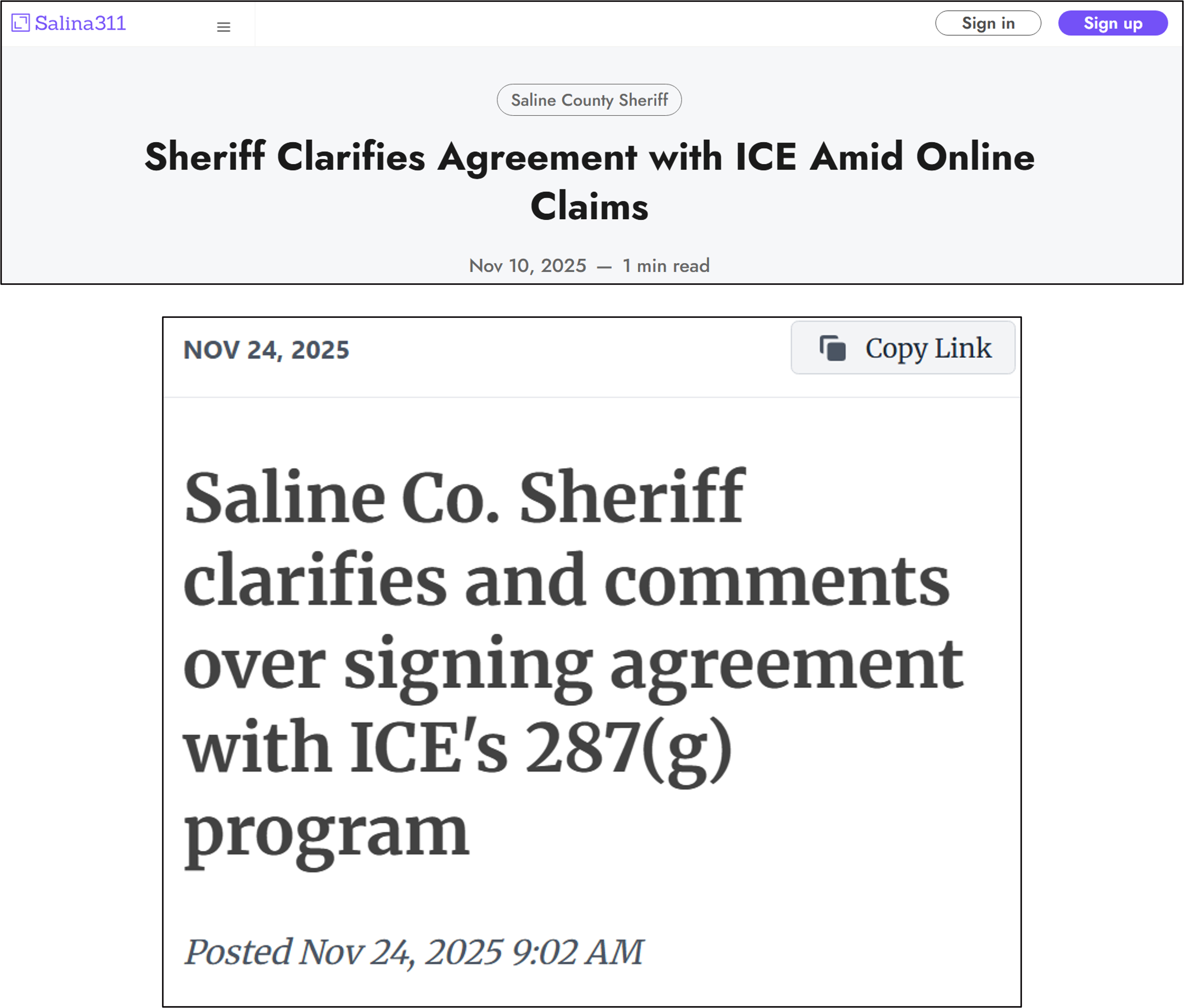
On November 24, allegedly “clarifying” his office’s entry into a 287(g) agreement with ICE, Saline County Sheriff Roger Soldan told the Salina Post, “This option doesn’t make any significant changes to the relationship the Sheriff’s Office has with ICE.”
No local media I can find have questioned or investigated, let alone pushed back on Soldan’s same-old, same-old narrative, which we can see in the following passage:
“The Sheriff’s Office has always honored ICE detainers that are placed on inmates already in our jail.” [Soldan said]
Under the Warrant Service Officer Program, ICE trains, certifies and authorizes local and state officers to serve and execute administrative warrants on aliens currently in custody.
Soldan stated ICE is completely funding the training for the deputies, and that no county dollars are being used.
He also explained the process of what happens when inmates are brought into the jail system within the county, and what happens if ICE were to request a detainer.
“All inmates brought into the jail for local charges are fingerprinted and the personal information and charges are electronically transmitted. Should any outside agency, including ICE request a hold on the inmate we place a hold on them and once they are done with the local charges, that agency is notified to come and pick up their detainee, provided a confirmation of the warrant has been sent to us prior to our releasing the inmate.”
In the context of ICE, the federal officers have 48 hours to pick up the detainee once done with local requested charges. If they do not, then the Sheriff’s Office will release the inmate from custody.
“In the case of ICE, they have 48 hours to come and pick up the inmate from the point we are done with local charges. (Excluding Weekends and Holidays) If they do not arrive in time, the inmate is released from custody,” said Soldan.
Why would local media push back on this “calm down” framing? Because it leaves out a lot, and walks right up to the line of flatly lying about what’s happening.
Let’s get into it.
“The Sheriff’s Office has always honored ICE detainers that are placed on inmates already in our jail”
Suggesting false dichotomies is a trick of deceptive framing.
Soldan seems to be offering only two options. He can “honor ICE detainers,” or his personnel…can go rogue and release folks with ICE detainers immediately after the agents who served the papers drive out of the jail parking lot—maybe while flipping them the bird and yelling “F*ck ICE!”
To be clear, those aren’t the options on the table.
Soldan could have just done nothing. He could have reviewed his oaths as a law enforcement officer and maybe scanned the Constitution, then looked around at what ICE, DHS, and CPB have been doing in the country, what the administration has been saying and publishing about non-white, non-Christian, non-European people living here, and said, “No, I’m not going to help with that.”
Soldan could have requested no 287(g) agreement at all. He could have just kept doing what the SO has always done: complied with the law and let the feds expend their resources if they were really committed to snatching up people. They have the budget, after all. Hell, they have a budget that dwarfs the budgets of entire militaries of several sovereign nations of the world.
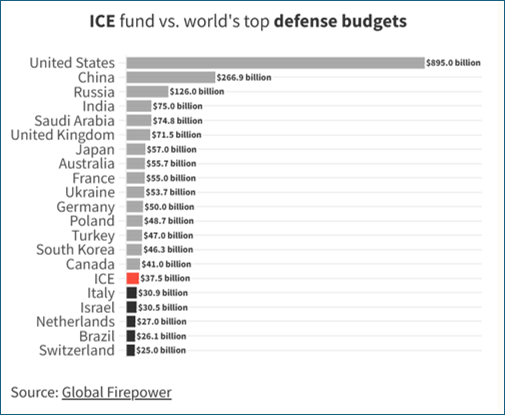
Instead, Soldan complied in advance. He now seems to want to present his pursuit of a 287(g) agreement as “no biggie,” just a continuation of the status quo the Sheriff’s Office has always maintained. In the words of his colleague Sheriff Jeff Easter in Sedgwick County, he wants us to believe that the 287(g) agreement is “about codifying an existing relationship with ICE.”
But it’s like your agreement with a credit card company: you may pay them $100 a month to knock down your balance and think you’re doing fine; but they might change the terms and start charging you 76 percent interest, and suddenly your “status quo” doesn’t really seem so normal anymore.
TRAC-ing the Status Quo
The Salina Chapter of Democratic Socialists of America dug into data collected by TRAC, the Transactional Records Access Clearinghouse, “a data gathering, data research, and data distribution organization that was founded in 1989 at Syracuse University.” Their mission is
to provide the American people — and institutions of oversight such as Congress, news organizations, public interest groups, businesses, scholars, and lawyers — with comprehensive information about staffing, spending, and enforcement activities of the federal government. On a day-to-day basis, what are the agencies and prosecutors actually doing? Who are their employees and what are they paid? What do agency actions indicate about the priorities and practices of government? How do the activities of an agency or prosecutor in one community compare with those in a neighboring one or the nation as a whole? How have these activities changed over time? How does the record of one administration compare with the next? When the head of an agency or a district administrator changed, were there observable differences in actual enforcement priorities? When a new law was enacted or amended, what impact did it have on agency activities?
Looking at TRAC data for the Saline County Jail going back 17 years, we can get a picture of how the Sheriff’s Office has worked with ICE, historically. This approach is better than merely taking Soldan’s assertions as fact as he tries to reassure his voters that “there’s nothing to see here, folks, move along.”
During those years, 378 ICE detainers were issued, and in only 46 percent (177) of those cases was the person taken into ICE custody. One hundred and ninety detained persons were not. Forty-three people with ICE detainers were convicted of a crime, yet ICE did not take them into custody.
Could these low numbers be due to the logistical annoyance of having to drive to Salina to serve warrants, then drive back to collect and transport those detained to ICE facilities? Might it reflect different ICE enforcement priorities under previous administrations?
Of the 177 people actually turned over to ICE during that 17-year span, 24 percent (42 people) had no criminal record. Thirty-one of them (18 percent) had been charged but not convicted. So: legally innocent people, to put it plainly. They never had their day in court.
Nationally, it seems much the same. The Guardian reported that ICE holds more people without criminal records than people with criminal records, back in September. (The lag in reporting owes a lot to the feds not publishing the legally required numbers during the recent shutdown.)
If this pattern is the status quo that Sheriff Soldan wishes to assure us will continue—in order to assuage any worries about injustice in our community—well, I doubt it will make anyone happy:
If you hate and fear the undocumented, you have to contend with 50 percent of detained persons never being scooped up by ICE during those years. (Odds are, you’ll blame Biden and Obama, ignoring that Trump I was wedged into that timeframe as well.)
On the other hand, if you get squeamish about punishing people without trial and conviction, when circumstantial evidence of their background shows they aren’t repeat offenders or habitual criminals, “the worst of the worst,” then a quarter of ICE’d people who had no criminal record and a fifth of them who had charges but no convictions should infuriate you.
“I am altering the deal. Pray I don’t alter it any further”
But it turns out, it isn’t just ICE that’s changed its end of the arrangement with Saline County.
Soldan has, too. Though he has not admitted to it, and his comments to media suggest he is lying about it, and they are none the wiser.
Details matter, and when we look into the details of what Soldan asked for in his 287(g) paperwork, we see that not only is ICE writ-large departing radically from past practices and goals, but Soldan is also changing the terms of his work with the agency.
Let’s suppose that, historically, relatively few undocumented folks were taken from our jail by ICE because it was a pain to drive to Salina to serve warrants and then collect them.
If that’s been part of the “problem” for ICE, Soldan’s 287(g) agreement fixes it for them.
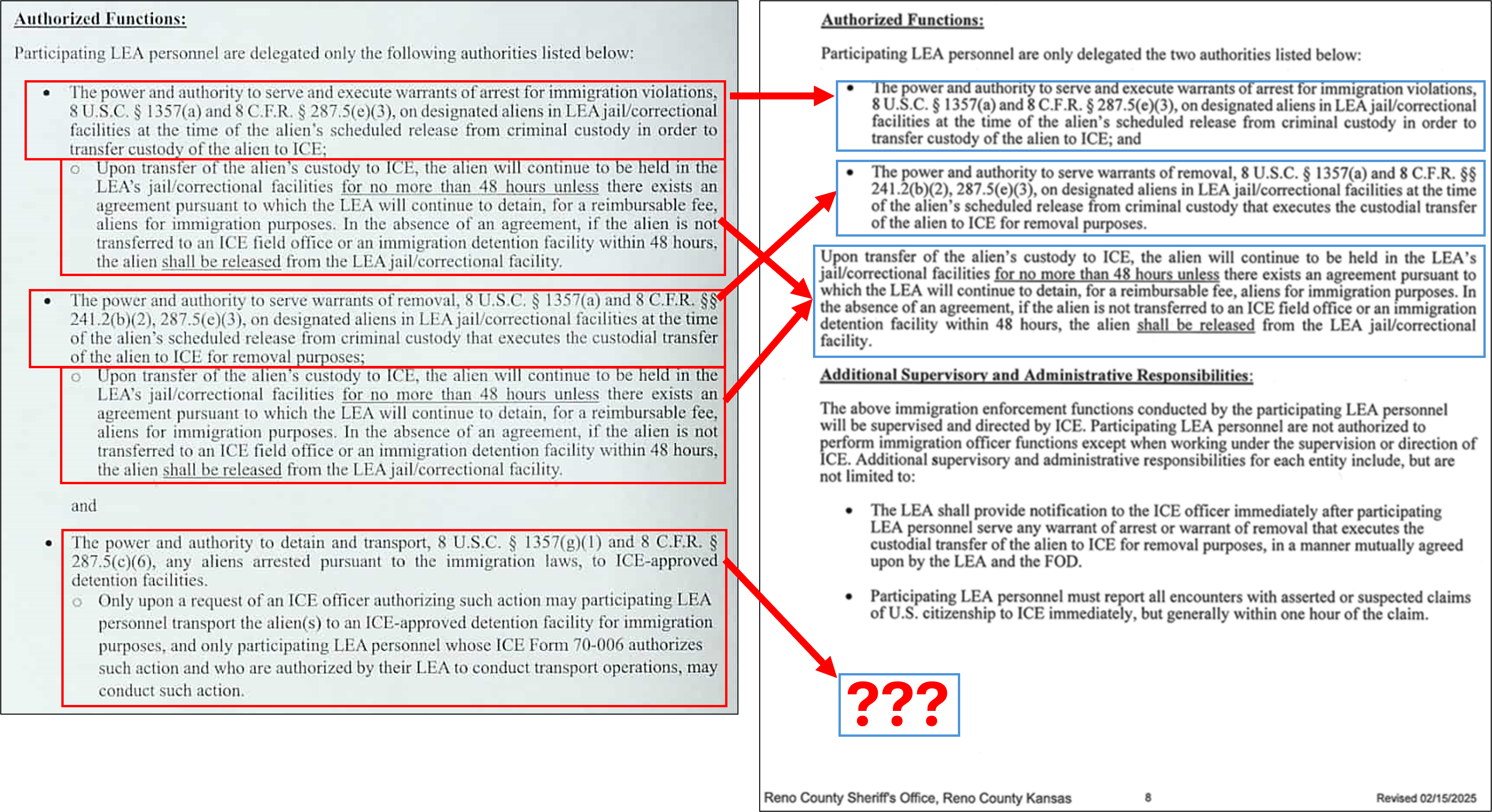
Take a close look at the agreement Soldan submitted:
To repeat what Soldan told The Salina Post about his entering into a 287(g) agreement: “This option doesn’t make any significant changes to the relationship the Sheriff’s Office has with ICE.”
Yet prior to this agreement, Soldan’s office did not, as far as anyone can tell, have the legal authority to “transport … aliens arrested pursuant to the immigration laws, to ICE-approved detention facilities.”
Now they will have such authority, thanks to Soldan. Remember, this is the sheriff’s own proposed agreement, not—contrary to the claims of Rush County Sheriff Mark Knowles1—one forced upon him by the federal government; he asked for this arrangement.
As shown by comparing the identical section of the agreement to one signed by Reno County (Hutchinson) Sheriff Darrian Campbell, Soldan’s agreement specifically includes the transportation clause, while Reno County’s does not. If Soldan simply signed a boilerplate, standard 287(g) WSO agreement, one would expect it to be essentially identical to other counties’ WSO agreements, but Saline County’s includes the authorization to truck prisoners to ICE holding and detention facilities.
To date, no reporters or media outlets have asked Soldan about this difference, or even seem aware of it.
Why does this matter? Because Soldan’s version of the 287(g) agreement spares ICE from having to come to Salina at all. No intimidating raids. No masked dudes in wraparound shades, gaiters, camo, and body armor kicking in doors of helpless brown people. Such bad optics. Makes the hippie-types upset. Makes it look like Soldan is allowing “nests” of “migrant vermin infest” our beloved small town, requiring the feds to come in and fix it.
Sure, it means our Sheriff’s Office is doing the work of a massively overfunded federal agency for them, but if it spares Soldan scandal and embarrassment, that’s got to be good for his reelection prospects.
Another reason this matters is that it sure looks like Soldan flat-out lied to the media, which means he lied to his constituents, when he claimed he made no significant changes by entering into the 287(g) agreement.
But the ability to transport detainees to ICE facilities is a significant change…
First, because it looks like an outlier compared to other counties’ 287(g) agreements.
Second, it removes a major reason for ICE (with its attendant controversy) to ever come to Salina. It’s a tiny clause that potentially exempts the town embarrassment, national coverage, division, etc. Complying in advance to preserve Salina’s image of a place safely tucked away from, or above, the controversies roiling other parts of the country. That’s a huge narrative deception accomplished with the stroke of a pen.
Third—and hilariously—it actually screws over the very media folks he’s saying this stuff to, since by keeping ICE away, he’s depriving their outlets of those juicy photos and stories that drive clicks and comments (I just helped make your content more boring!), and they don’t seem to realize this. Dear media: you’re getting played.
Fourth, he moves his office’s complicity with a nationwide mass deportation, even kidnapping, operation underground and in-house, to hide any increase in material cooperation (like, chauffeuring 100% of the undocumented folks in his jail to ICE after only a phone call or email, regardless of past criminal history, severity of alleged offense, or legal presumption of innocence and no conviction).
The biggest problem, let’s be clear, with Soldan’s “maintaining the status quo” framing is simple: while Saline County is departing from its side of the status quo to cooperate more closely with the feds, it comes at a time when the feds have radically changed the immigration game on their end.
We’re just doing what we’ve always done is a lie. “What we’ve always done” used to be allowing undocumented people to be taken into a highly rigged federal immigration system that sorta prioritize deporting the violently criminal. That system now has no focus beyond “mass deportation now” regardless of convictions and criminal histories. We used to put some folks into a holding cell for ICE to come get, after ICE had shown sufficient interest and devoted sufficient resources to deporting them. Soldan’s agreement frees ICE of even this much effort, and allows his own people to deliver the undocumented to ICE’s door like some cannibalistic version of Uber Eats.
Pretending that what’s happened in Chicago, Charlotte, and Los Angeles, is somehow divorced from ICE operations elsewhere is delusional. Telling media that nothing has changed on Saline County’s end is belied by the very documents Soldan submitted.
Other Fibs and False Framings
Soldan presents a picture of his ICE cooperation as “Nothing to see here, folks, please move along.”
That is, the public should—in Soldan’s framing—view the 287(g) agreement he proposed as a continuation of the status quo. This is manifestly false. First, prior to this arrangement, ICE officers would have to travel to Saline County to serve their own “warrants of arrest.” Second, ICE officers would have to travel to Saline County to serve their own “warrants of removal.”
Now, Saline County personnel will spare the massively funded agency that bother, after having been trained to serve such warrants themselves.
This makes ICE’s job easier for them. Perhaps it is not a major favor to the agency in this one, isolated case, it certainly lightens the workload of ICE in some respect, and across nearly 1200 law enforcement agencies in 40 states (as of November), the logistical assist to the federal government starts to look quite substantial. ICE hardly needs any more help, as our tax dollars are already funding a historically unprecedented surge of funding to the agency and its allied anti-immigrant peers.
It’s a collective-active problem, the kind us individualistic Americans really suck at solving and even have a hard time recognizing. The more 287(g) agreements signed, the easier ICE’s job gets. The easier ICE’s job gets, the more innocent and law abiding people get swept up in this racist purge based on civil offenses, despite whatever Soldan may say about how he has no role in enforcing immigration rules or targeting people based on national origin, skin color, race, ethnicity, language, etc.
But there’s a third way in which Soldan is falsely framing his cooperation with ICE. Not only would ICE agents have to travel to Saline County to serve various warrants, they would also have to drive out to pick up any detained persons Soldan was holding for them, and take these people back to ICE facilities. Under Soldan’s new agreement, they don’t have to do that either: Saline County personnel are now in the prisoner transport business for ICE as well.
There is zero mention of this new aspect to the county’s ICE cooperation in any of Soldan’s interviews.
And, as the comparison to Reno County’s agreement shows, it seems like Soldan is actually going above and beyond the minimum level of cooperation with ICE by requesting this transportation clause.
But again, you’d never know it from what Soldan says, and you’d never discover it from his media interlocutors.
“No county dollars are being used”
Again: “Soldan stated ICE is completely funding the training for the deputies, and that no county dollars are being used.”
For the training, let’s be clear.
But every minute of time spent preparing and serving the arrest and detention warrants on ICE’s behalf will be done on the county’s dime, as far as I am aware. If this is not so, then presumably Soldan will clarify this in his next blitz of media image management. Perhaps he can provide documentation that ICE will reimburse his office for the time-on-task his people spend working for the feds on these matters, contra this section of the agreement:
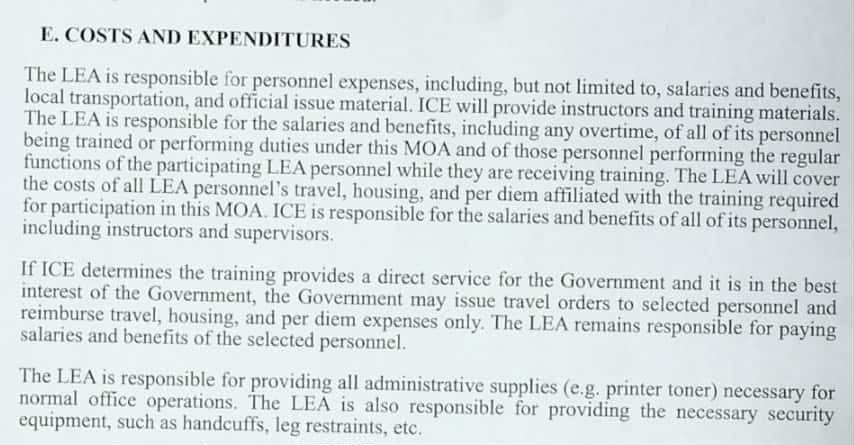
Now maybe it takes only five minutes to print off and fill out an ICE administrative warrant and walk it down to an incarcerated person. Not that big of a cost to a county employee already performing his or her duties, sure.
But as I read these documents, Saline County personnel who transport prisoners to ICE facilities will be on the county’s dime for drive time to the cities where those facilities are located, effectively taking our employees out of local service and tasks for at least half a day each time. Depending on how often this massive federal agency decides to lean on its friend Roger Soldan, those trade-offs and expenses could mount. If mass deportation is the goal, we should expect frequent detainee-transport trips—no more of this measly 46 percent taken in to ICE custody nonsense. Gotta pump those numbers up. Those are rookie numbers.
But just as Soldan never mentioned the special prisoner transport section of the agreement he signed, he carefully avoids any mention of county dollars paying for the time off the tasks of Saline County constituents here at home.
Again, an on-the-ball reporter should have caught this omission and at least asked about it. (I could be mistaken in how I read this document, and if I am, I surely would like the professional journalists allegedly serving my community to set me straight.)
“If they do not arrive in time, the inmate is released from custody”
Again, Soldan’s omission of the unusual prisoner transport authority in his agreement with ICE is significant, given the claims he makes in local media. He continues to act as if the issues of federal immigration are out of his hands, shruggingly claiming, “If they [ICE] do not arrive in time, the inmate is released from custody.”
That’s the old arrangement, where ICE had to come to Salina. Soldan’s new transportation clause in his agreement makes this claim false. If ICE does not arrive in time—if ICE doesn’t even feel like driving all the way to Salina, in fact—the agency need only request Saline County’s trained personnel drive “the inmate” to them. Soldan’s agreement turns his people into ICE’s potential human traffickers.
And again, this appears to be at Saline County’s expense.
A Story That Doesn’t Scan
Soldan spoke to KSAL’s Jeff Garretson on November 19 about the reason he allegedly changed his mind about the 287(g) agreement.
I signed this agreement on Sept. 11 – and what precipitated it for me was on Sept. 10 we worked a case with some folks out in the county that had been the victims of about a little more than a $75,000 scam. There’s a couple of foreign nationals that were here, they’re here legally, but they’re in the United States as students somewhere northeast, and they came to Kansas to pick up a box of cash they’d talked these people -- convinced these people they needed to pay. Well they’d already paid $75,000 and they were coming to pick up I don’t remember how much the exact amount was. So we arrested those two guys, and of course they had never been previously deported or anything else, but immediately we found out that they were suspects in crimes all over the country, but they weren’t wanted by ICE, and, you know, we don’t report to ICE or anything, but in that case I didn’t want them to be able to post bond and leave the country and any chance that we got of getting the victims money back was gone with them. And so that’s kind of what -- so the very next day I signed this agreement.
Let’s be clear: the case Soldan describes is heartrending. Scamming folks is despicable. If there’s not a circle in Hell devoted to people who do this, one needs to be constructed immediately. But telling a story about crime victims to justify something that just doesn’t make sense is a common tactic to emotionally cloud critical scrutiny, and I think Soldan is doing it here.
The alleged scammers, Soldan says, were in the country legally, one presumes, on student visas. They were not wanted by ICE. They were suspects in crimes in other jurisdictions, but Soldan doesn’t say they were charged or had warrants for their arrest in those jurisdictions.
What Soldan never explains—and what Garretson never asks—is how Soldan’s 287(g) agreement with ICE materially changes anything concerning these alleged scammers. If they are not on ICE’s radar, then ICE won’t even request Soldan’s people to serve warrants of detention on them.
If they are charged and/or convicted in Saline County, then ICE may request warrants be served on them, but they could serve such warrants themselves—assuming that committing major fraud violates a student visa holder’s immigration conditions. If it doesn’t, then that’s something to take up with lawmakers and immigration officials in a political arena.
If Soldan was particularly moved by the plight of the victims in this case, there is nothing I’m aware of in law or policy that prevented him from phoning up ICE and alerting them to the case and the immigration status of the alleged scammers, of their suspect status in other jurisdictions, in hopes of getting ICE to place a big red flag on their names. But he could have done this without signing a 287(g) agreement. And with or without an agreement, he would be calling ICE’s attention to foreign nationals legally present in the United States, not people who had sidestepped immigration rules or slipped across a border in the dead of night.
Soldan says, “I didn’t want them to be able to post bond and leave the country and any chance that we got of getting the victims money back was gone with them.” This, too, doesn’t make much sense. Posting bond would have allowed the alleged scammers to skip town and state and maybe the country, and that would have been bad. But what’s the alternate scenario here?
Soldan signs a 287(g) agreement that doesn’t allow him to do anything about these alleged scammers he couldn’t have done before. He says he signed it to prevent these people from, basically, fleeing the country and escaping their obligation to make restitution to the scam victims. But what does ICE do with people in its custody? It deports them. To other countries. Where U.S. law presumably has a harder time wresting restitution dollars from their pockets and bank accounts.
The logic of this just doesn’t track. As an explanation, it’s gibberish, and the nonsense is hidden by the sympathy we feel for the scam victims and contempt we feel for anyone who would rip such folks off.
If I try to make sense of it, I come up with three possibilities:
Soldan is deliberately trying to paper over his real reasons for signing the 287(g) agreement with this tale, knowing that emotions will trump reasoning here and few people will scrutinize the thinking he claims was behind his decision.
Soldan really did reason just as he says, in which case, boy, he seems pretty damn dumb.
Soldan got mad at some foreign nationals he believes should be treated like “illegals” and jumped into bed with the agency that is cracking down on them, which suggests at best he likes to look for loopholes to sidestep legal niceties, and at worst, he has some issues with “foreigners.”
I honestly don’t know which option seems more likely. I tend to gravitate toward a mixture of all three merging on subconscious levels, but I don’t know the man personally. All I can say is that the story doesn’t seem to hold up.
I’m not a LEO, of course. I could be overlooking or ignorant of something that makes the whole narrative gel and slot into place, but I sure know it doesn’t pass a rudimentary smell test, and if I had been in the interview with Soldan, I sure as hell would have made him walk me through the logic of it, step by step, voicing the very objections above.
Instead, we got audio clips that we had to transcribe manually to parse.
The media is failing us locally. In the first instance, it was DSA Salina that broke the story of Saline County switching gears and signing a 287(g) agreement.
Local media rolled out the red carpet for Sheriff Soldan to placate concerns and inaccurately claim that nothing had really changed at all, with only one outlet referencing our role in the story (but not contacting or interviewing us).
Now, we’re looking at their coverage and finding softball fluffery allowing Soldan to pass off incoherence without question, let alone pushback.
I get that journalism sucks right now as a career, folks. I get that you work for companies owned by reactionary CHUDs who would have been at January 6 if only they’d had more guts, and you have to be super careful as you thread the needle in your coverage. And I know you have to urgently pump out content, and you’re under institutional and business-model pressure to jump from topic to topic, story to story, and nobody wants to pay to dig deeper on any one thing.
But I clean toilets. DSA Salina is entirely member dues funded, all volunteer, just leveraging the passions and skills of its members. So cry me a river and do better.
UPDATE: In my last entry here, I discussed Knowles’ claim, on Facebook, that if he did not enter into a 287(g) agreement with ICE, his entire county would be defunded by the federal government. I found that claim unlikely, and I referenced an analogous federal case as support for my skepticism.
Turns out, Sheriff Soldan spoke to this question, obliquely and without naming Knowles, but presumably springboarding off this newsletter’s coverage, in his discussion with KSAL:
“I have to ask, did you feel any pressure from the federal government to sign this kind of an agreement?”
“You know, I didn’t feel it from the government. The National Sheriff’s Association sent a thing out early in the year saying that, you know, anybody that basically there was an order that -- it had the spirit of anybody that didn’t sign it would be considered a sanctuary county and as such the county would be ineligible for any federal funding. And every sub- so the city of Salina and everyone else. Well, you know, that didn’t really convince me we needed to do this. It wasn’t that, it was just, if someone commits a crime, you know, I took an oath to uphold the constitution of the United States and the state of Kansas. And as a law enforcement officer I think if you’re a criminal we’re gonna do that, you know. And it’s not a crime to be in the country -- it’s not a crime to be here illegally. It is a crime to be here illegally if you’ve previously been deported or you’re committing felonies.“
I can’t get ahold of the NSA’s “thing” (presumably its newsletter from around January or February), because I’d have to sign up to receive them and I’m not a LEO, and even then access to past issues is uncertain. But a comrade’s digging clarified that the legal case that’s probably on point here is City and County of San Francisco v. Donald J. Trump. That case looks strong as a rejection of the feds’ power to defund local services over immigration matters.
Despite all this, Sheriff Mark Knowles’ Facebook post, claiming he entered the 287(g) agreement because doing otherwise would result in systemic defunding to all of Rush County, remains up, unchanged and unamended as of this writing.
Maybe don’t trust and believe county sheriffs unless they show you proof and walk you through things that don’t make sense.